
John Adams and the Library of Congress

John Adams is well known for many roles — patriot, diplomat, second president of the United States, first vice president, husband of Abigail, and father of John Quincy (the sixth president). His link to the Library of Congress is less often cited. More often, the role of Thomas Jefferson in rebuilding its collection is recalled.

In 1980, an annex to the main Library building (the Jefferson Building) was renamed to commemorate the role Adams played in 1800 by signing a bill establishing “a reference library for Congress.” The original library, built with $5,000 appropriated by the legislature, was housed in the new Capitol Building in Washington, DC. But this collection was short lived.

In August 1814, invading British troops set fire to the Capitol, destroying much of the small library. It’s here that Jefferson steps into the story. The Library of Congress website notes:

Within a month, retired President Thomas Jefferson offered his personal library as a replacement. Jefferson had spent 50 years accumulating books, “putting by everything which related to America, and indeed whatever was rare and valuable in every science”; his library was considered to be one of the finest in the United States.

In offering his collection to Congress, Jefferson anticipated controversy over the nature of his collection, which included books in foreign languages and volumes of philosophy, science, literature, and other topics not normally viewed as part of a legislative library. He wrote, “I do not know that it contains any branch of science which Congress would wish to exclude from their collection; there is, in fact, no subject to which a Member of Congress may not have occasion to refer.”

In January 1815, Congress accepted Jefferson’s offer, appropriating $23,950 for his 6,487 books, and the foundation was laid for a great national library. The Jeffersonian concept of universality, the belief that all subjects are important to the library of the American legislature, is the philosophy and rationale behind the comprehensive collecting policies of today’s Library of Congress.
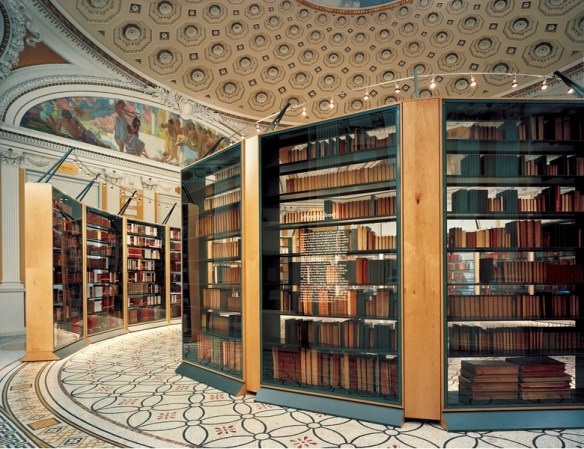
Jefferson's library

Thomas Jefferson’s Library, permanent exhibit | Library of Congress

An editor’s toolbox

All editors have favorite grammar and style references, along with an assortment of dictionaries and specialized resources that help them solve tricky problems of grammar and syntax. Although many of these manuals and style guides are now available online or as e-resources, most editors still rely on an assortment of physical  books. Here are a few of the go-to classics on my bookshelf:

The Copyeditor’s Handbook, by Amy Einsohn and Marilyn Schwartz (4th edition, 2019; a comprehensive editing resource that can be read cover to cover or dipped into as necessary for guidance on grammar, style, and the editing process in general)

Dreyer’s English, by Benjamin Dreyer (2019; subtitled “an utterly correct guide to clarity and style”; a reminder of why the world needs editors, by the copy chief of Random House)

The Careful Writer: A Modern Guide to English Usage, by Theodore M. Bernstein (2nd edition, 1995; Bernstein was chief of the copy desk for The New York Times, and his book is unmatched for its delightful assortment of entries extolling good writing while advocating against too-rigid rules of grammar)

The Elements of Style, by William Strunk Jr. and E.B. White (4th edition, 1999; worth rereading every few years as a refresher)

Line by Line: How to Edit Your Own Writing, by Claire Kehrwald Cook (1985; the former editorial director of the MLA, Cook wrote the book to show readers “how to make what you say as good as what you mean” — which she does using careful explanations and hundreds of examples)

Medical English Usage and Abusage, by Edith Schwager (1991; hailed as the grande dame of medical editors when she died in 2012, Schwager filled her book with easy-to-read advice, and it remains a valuable guide for anyone who edits medical copy)

BOOKSHELF ENVY

John Adams Building | Library of Congress

Built between 1928 and 1938, the Adams Building was intended as a “functional and efficient bookstack” to hold the rapidly expanding collection of the Library of Congress, then housed in the neighboring Jefferson Building. The metrics are astonishing: Its 180 miles of shelving hold 10 million volumes in 12 tiers of stacks that extend from the cellar to the fourth floor, with each tier providing about 13 acres of shelf space. (Sources: Library of Congress, Architect of the Capitol) And the decorative details within and without are an artistic treasure, as well. They’re featured throughout my website.

(All photographs of the Adams Building and Library of Congress interiors by Carol M. Highsmith, collection of the Library of Congress)

What type of editing do you need?

Copy Editing (Line and Substantive Editing):

The terms copy edit and line edit are often used interchangeably. In a copy edit, I will:

  • Make line-by-line changes that impose standard spelling, grammar, usage, style, and punctuation throughout your manuscript.
  • Correct or flag to your attention redundant, conflicting, or unclear statements.
  • Check references and endnotes and revise them as necessary to ensure adherence to a designated house or publication style.
  • Check cross-references, compare information in figures and tables with statements in the narrative, and correct or flag any discrepancies.
  • Provide a detailed style sheet summarizing stylistic changes to your manuscript.

In a substantive edit, I’ll provide a more intensive edit that addresses issues of content (accuracy, currency, scope), organization, and writing style (flow, readability), in addition to line editing your manuscript. Here is an example (PDF format):

Sample edit: clinical manual

Development Editing:

Books that are designed for the highly competitive academic textbook market often undergo rigorous development. In a development edit, I will:

  • Provide in-depth analysis of the scope, organization, intellectual level, and tone of the proposed work to ensure that your book meets the needs of its market.
  • Review competing titles, evaluate market trends, and elicit or evaluate feedback from reviewers.
  • Evaluate and offer suggestions to enhance the use of tables, boxes, special features, and art.
  • Provide a substantive edit, including suggestions for rewrite, reorganization, and reformatting of information.
  • Work with you to incorporate market feedback and editorial suggestions into the final, production-ready manuscript.

“Whatever the cost of our libraries, the price is cheap compared to that of an ignorant nation.”
― Walter Cronkite